Giant Hogweed fact sheet
Health Hazard
Giant Hogweed can be a serious health hazard for humans.
Its watery, clear sap contains photo-sensitizing compounds which, when in contact with human skin and in combination with ultra-violet (UV) radiation, can cause burning.
The reaction of the skin depends on individual sensitivity.
After 24 hours, reddening and swelling of the skin may be noticed.
This may be followed by an inflammatory reaction after three days.
Depending on individual sensitivity, effects can last for months and skin can remain sensitive to UV light for years.
The plant also has the potential to blind, temporarily or permanently.
Read about this dangerous plant in this local fact sheet:
- Giant Hogweed Local Fact Sheet – Ausable Bayfield Conservation – 2 MB (Very large) PDF file
If You Become Exposed to Giant Hogweed
If you become exposed to Giant Hogweed:
- Wash the affected areas immediately with soap and water if available.
- Keep affected areas out of direct sunlight.
- Seek medical advice as soon as possible.
Control and Removal of Giant Hogweed
Here are suggested guidelines, from various agencies, for control and removal of Giant Hogweed.
Ausable Bayfield Conservation Authority does not assume liability for any health concerns that may arise from coming into contact with the plant.
- Suit up with protective clothing, including waterproof gloves, long-sleeved shirts and pants, disposable spray suit coverall over top of clothes, safety glasses, and face shield. Wash gloves with soap and water before removing spray suit. Wash rubber gloves before removing. Remove protective eyewear last.
- Removal or control of Giant Hogweed should not be done at the brightest time of day.
- For smaller plants, in early May, cover the area with black plastic to smother growth or use glyphosate (e.g., Roundup). Cover area in mulch 10-14 days after, to reduce germination of other seeds.
- For flowering plants, cut white flower head in early July before turning green and producing seeds. You may need to cut flowers a month later. Carefully place flower heads from stems into black plastic bags. Tightly seal the bags and leave in direct sunlight for one week. Do not burn or compost.
If in doubt about appropriate removal, contact a professional.
If you see Giant Hogweed:
- Report it to your local municipal weed inspector
- Send location, when confirmed, to the invasive species tracking system website at invadingspecies.com
- If it is on the property of Ausable Bayfield Conservation Authority call 519-235-2610, or toll-free 1-888-286-2610, or email avanniekerk@abca.ca
- Please provide digital photos of the leaf, stem, and flower (taken at a large distance from the plant using a zoom lens)
- Please remember to be very careful and DO NOT TOUCH THE PLANT unless you have proper protection.
Often mistaken for:
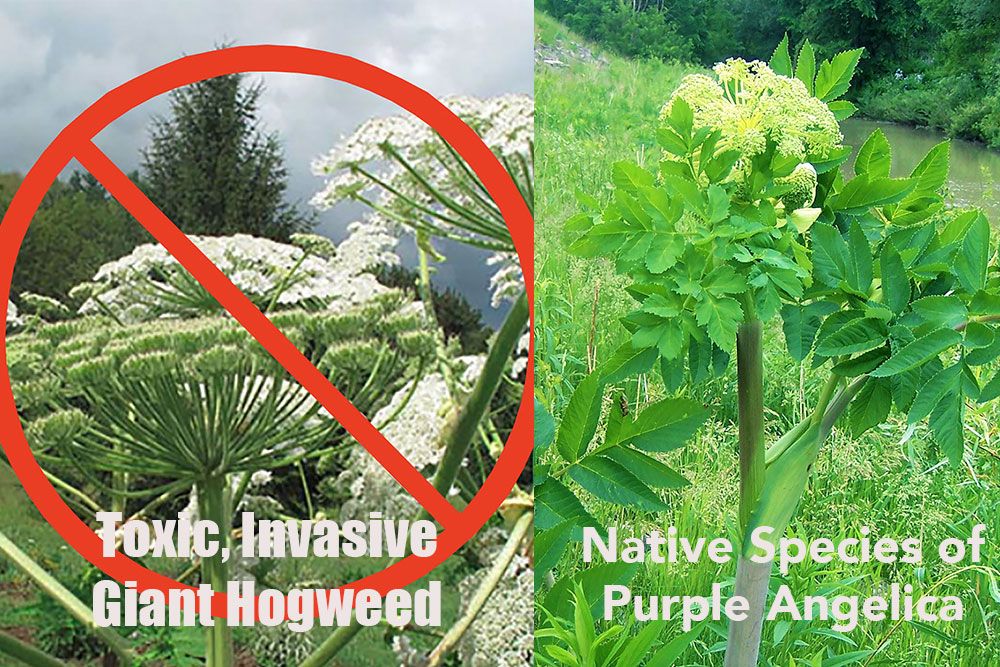
Giant Hogweed has been mistaken for other species, especially others in the carrot family such as Wild Carrot, Water Parsnip, and Angelica.
The most distinguishing feature of Giant Hogweed is its giant size – as a mature plant it towers above these other species.
Description of Giant Hogweed
Giant Hogweed – Heracleum mantegazzianum
- Hazardous to humans
- Invasive plant
Giant Hogweed has large, flat-topped to slightly dome-shaped flower and seed head and a bumpy or bristly stem.
Plant: Mature plant grows taller than a grown adult, eight feet to 14 feet tall (up to five metres in height), with green to reddish-purple stem, stem and leaf stocks, not smooth but with raised reddish purple nodules, forming bumps or bristles.
Flower: Numerous white flowers clustered in an umbrella-shaped head up to 2.5 feet in diameter.
It blooms from spring to mid-summer.
Leaf: Large, compound, deeply incised, and three to five feet wide, leaf edges – bristle tipped or spiky.
Habitat: Roadsides, streambanks, waste areas, yards.
Status: Introduced as an ornamental from Asia.
Description of Purple Angelica
Purple Angelica – Angelica atropurpurea L.
- Not hazardous
- Native plant
Purple Angelica has large spherical flower and seed head and smooth stem.
Plant: Plant is four to eight feet (2.5 metres) tall.
Stems are smooth, reddish, hollow.
Flower: Flower is white to green, five-parted; inflorescence a four-inch to eight-inch, ball-like, compound umbel; blooms June-August.
Leaf: Leaf is subdivided into three to five segments, large but smaller toward the top, on a two inch to four inch clasping stalk. Leaf edges toothed.
Habitat: Full to partial sun; wet; meadows, woods, stream banks, fens, springs; in muddy soil.
Status: Native. Purple Angelica is common in the flood plains along the Ausable River and its tributaries.
Learn More
To find out more visit abca.ca or invadingspecies.com or ontarioweeds.com.
Report presence of plant to your local municipal weed inspector and Invading Species Hotline at invadingspecies.com or 1-800-563-7711
Photos of plants on Ausable Bayfield Conservation Authority property can be sent to avanniekerk@abca.ca but DO NOT get near plant.
Ausable Bayfield Conservation Authority (ABCA)
71108 Morrison Line, RR 3 Exeter, ON N0M 1S5
519-235-2610 • 1-888-286-2610 • abca.ca • info@abca.ca
This information is provided for information purposes and is provisional and subject to change.