Impact of invasive plants is costly
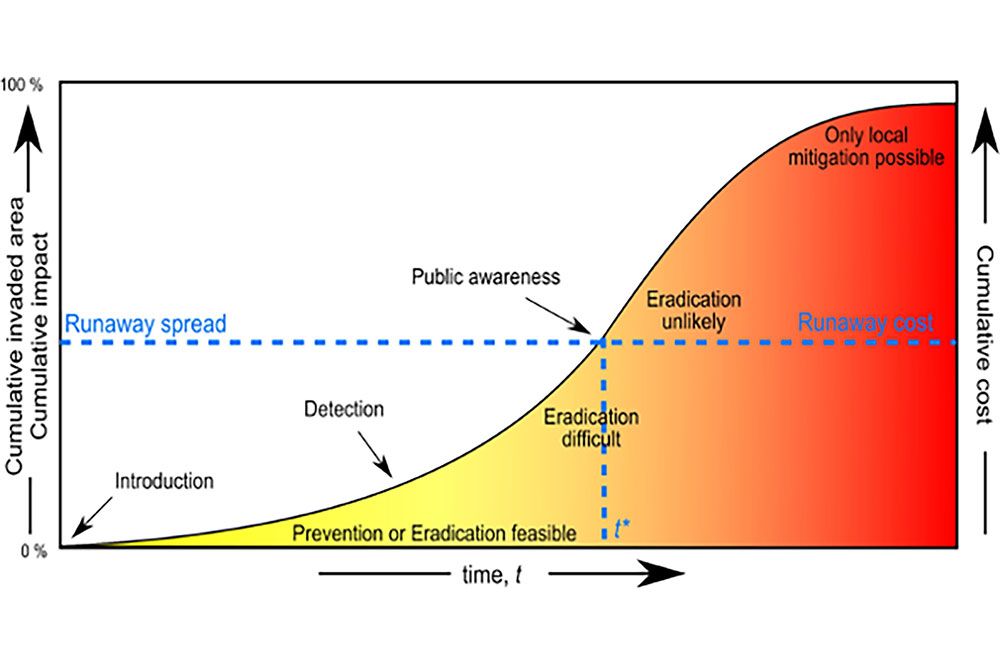
IMAGE: Invasion curve illustrating how costs rise with time and spread. Source: F. Herald, 2022.
By Renee Sandelowsky and Helen Varekamp
Renee Sandelowsky and Helen Varekamp are Bayfield residents and local volunteers. They are writing a monthly series of articles about the benefits of planting native species of plants and the need to remove invasive species. This month (August 2026) they are writing about the cost of invasive plant control.
The costs of invasive plants in Canada are massive and under-reported, although some market impacts, such as crop loss, pesticide costs, restoration, equipment and labour costs, have been determined.
In 2008, the Canadian Food Inspection Agency (CFIA) reported yield loss and invasive plant control costs of approximately $2.2 billion annually in the agricultural sector alone.
The annual cost of invasive plant management in urban forests was estimated to be between $95 million and $400 million in 2021, according to Canadian municipalities. Invasive plants can damage trees and cause disruptions to the ecosystem.
Costs of control often fall on municipalities and non-governmental stakeholders. Across Canadian municipalities, recent surveys indicate that an average of $248 million annually was spent on invasive species management. Of the five invasive species most frequently reported as a top priority in Ontario (this includes animal species), three of those were plants — Phragmites (European common reed); Giant Hogweed; and Wild Parsnip.
A 2019 survey found that the management of Phragmites alone cost municipalities and conservation authorities more than $1.3 million.
Small communities and local groups are often forced to fundraise to mitigate invasive plant infestations. Currently, such costs are not well-reported to provincial or federal databases and volunteer hours are not quantified.
It is important to point out that the costs of invasive species management significantly increase as the likelihood of eradication decreases.
Preventing the initial introduction and spread of invasive species saves in long-term damages, management, and restoration costs. In fact, according to a European Union report by the Environmental Audit Committee in 2019, “it is hundreds to thousands of times cheaper to prevent invasive species from establishing, rather than tackling them once they are established.”
Regulatory actions that prohibit imports have the greatest impact and cost savings. Sadly, less than 20 per cent of funds spent by municipalities in Ontario are spent on prevention programs. Approximately 80 per cent of spending is directed to control and management.
Note that the costs of impacts on the environment, specifically biodiversity and services provided by nature, have not been included in the above-mentioned figures. Some services contributed by nature include, but are not limited to, resources such as food, wood and medicines, functions such as pollination, air purification, water filtration, flood and erosion control, nutrient cycling, climate regulation and carbon storage.
Let’s not forget that true costing would also need to consider the impacts of invasive plants on animal and human health as well as cultural heritage.
– Renee Sandelowsky and Helen Varekamp are Bayfield residents and local volunteers. They are writing a monthly series of articles, about the need to remove and switch away from invasive plants in favour of native species of plants, for the Canadian Coalition for Invasive Plant Regulation.