Turtle back home after injury
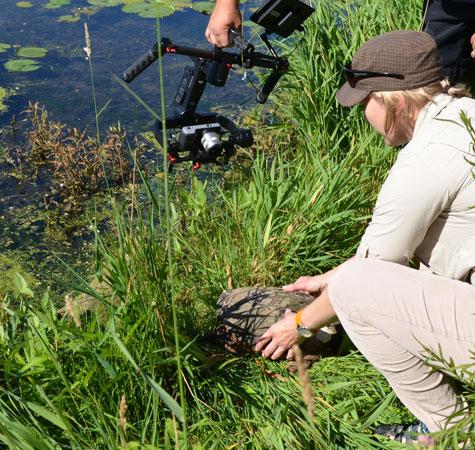
Huron Stewardship Council returns Snapping Turtle to local waters
Children at Ausable Bayfield Conservation’s Summer Nature Day Camp witness release into Morrison Reservoir of turtle rehabilitated after being hit by vehicle
An adult female Snapping Turtle, restored back to health after having had her shell cracked by contact with a vehicle, is back home in local waters.
Denise Iszczuk, a conservation educator with Ausable Bayfield Conservation, was on her way home from work in June of 2015 when she found the injured turtle on the middle of Highway 83. Turtle Haven, a wildlife custodian organization in Kitchener, rehabilitated the turtle after the injury. Huron Stewardship Council released the turtle into Morrison Reservoir east of Exeter on Thursday, July 23.
Twenty-two local children (ages 5 to 9) from throughout the Ausable Bayfield watershed, and even outside of the watershed, are taking part this week in Ausable Bayfield Conservation’s Summer Nature Day Camp. The campers were present to witness the turtle’s return to the watershed. The young people named the turtle Selena. The re-release of the turtle back into its habitat fits well with the protection of water, soil, and living things that students are learning about at camp, said Iszczuk. Several of the young campers talked about the return of Selena to her local area. “The best part was when we let the Snapping Turtle into the wild,†one boy at the camp said. “I didn’t know their shells were hard,†said a girl at the camp. One camper said they learned that Snapping Turtles snap because “they can’t go into their shell†to protect themselves. Another camper said “there are eight species that live in Ontario and seven of them are endangered.†One of the children said “if you see a turtle on the road and you can help it across.â€
Jory Mullen, Lead Species at Risk Technician, Huron Stewardship Council, released the turtle into Morrison Lake (or Morrison Reservoir), located at Morrison Dam Conservation Area east of Exeter. The care for this turtle, and its release back into the wild, are examples of how local people can help to protect these important species, she said.
There are eight native turtle species in Ontario. Seven of those species are at risk. The Snapping Turtle is one of those species at risk. It takes a long time for most turtles to reach maturity. Mature turtles may live for many decades but turtles reproduce at a low rate. When a mother turtle dies, or any adult turtle dies, there is an impact on the future of the species. A Snapping Turtle would need to lay about 1,400 eggs in her lifetime, on average, for just one of her offspring to survive to adulthood. Saving even one adult by safely helping it across the road, or taking an injured turtle, or a turtle carrying eggs, to a wildlife custodian, can help to conserve that species.
“When a turtle is injured, it is very important that people do what Denise did – protect the turtle, phone for expert help, and safely transport the turtle to a rehabilitation centre,†said Mullen. If a turtle is uninjured, move it across the road in the direction it was heading. If you find an injured turtle, it needs help and can be taken to a wildlife custodian.
“It is important to secure the turtle in a ventilated container with and then call for help,†according to Mullen. “Never assume the turtle will be in the location that you found it after you left it there. Some of the turtles can be saved, others have to be euthanized but their eggs inside them can be saved.†The container should have a secure lid. Note the location (road and major intersections) where the turtle was found to ensure it can be released according to provincial regulations. Do not transport turtles in water, according to the Huron Stewardship Council. Do not offer the turtle anything to eat. You may call an area wildlife rehabilitation centre with people who can help restore the turtles to health. “Even if the rehabilitation centre cannot save the turtle, they may be able to save the eggs inside her,†said Mullen.
Some wildlife rehabilitation centres include:
- Turtle Haven, 114 Mansion Street, Kitchener, Ontario, N2H 2J9. Phone: 519 745-4334
- Kawartha Turtle Trauma Centre, 1434 Chemong Road #4, Peterborough, ON, K9J 6X2. Phone: 705-741-5000
- Toronto Wildlife Centre, 60 Carl Hall Road, Toronto, ON, M3K 2C1. Phone: 416-631-0662
- Salthaven Wildlife Rehabilitation Centre, P.O. Box 601, Mt Brydges, Ontario, N0L 1W0. Phone: 519-264-2440 (Small turtles only, please.)
- Heaven’s Wildlife Rescue and Rehabilitation Centre. P.O. Box 119, Oil Springs, Ontario, Canada, N0N 1P0. Phone: 519-466-6636.
When someone finds a turtle crossing a road there are safe ways for that person to help the turtle go on in the direction they are headed. How do you correctly help a turtle cross the road? Never pick up a turtle by their tail as this can damage their spine. Always move them in the direction they are headed. You may grab a Snapping Turtle near the back of the shell. You may also use blankets, towels, shovels and car mats to transport the turtle across the road. A video about safe turtle transport, posted by Toronto Zoo Adopt-a-Pond, is online at: youtube.com/watch?v=Lgd_B6iKPxU
Each year, from May to July, many of Ontario’s freshwater turtles leave the safety of their wetlands, creeks or rivers. They do this as they make a trek in search of sites that are fit to nest. No area of land in southern Ontario is more than 1.5 kilometres from a road. That means turtles are likely to cross a road when they need to make this nesting journey. Road mortality is one of the biggest threats facing turtles. Another reason is the loss of the habitat turtles need in order to live.
Habitat destruction, poaching, and road mortality are all factors leading to the decline of turtles globally. Adult females are the most likely to be killed. They are vulnerable to mortality as they are the ones that have to leave the water to find a suitable place to lay their eggs. In the process, they have to cross several roads and many are hit by cars.
Turtles are one of the most threatened groups of animals on the planet, Mullen said. They have few offspring each year. (This is called low fecundity). Turtles also have delayed sexual maturity. Some turtles do not start reproducing until they are 25 years old. Very few juvenile turtles or hatchlings survive. Fewer than one in 100 turtles survive to adulthood. On the other hand, adult turtles have almost no natural predators other than humans. They also have a long reproductive rate, producing offspring until they die. “There is no menopause for turtles,†joked Mullen.
The local health of land and water depends on having diverse animals that each plays a role to keep that eco-system healthy. The turtle is a vital part of that system. Turtles help to control aquatic vegetation. Turtles serve as scavengers. This means they help clean our creeks and wetlands by eating dead and decaying fish and other organisms.
If you would like to find out more about turtles and how you can help monitor turtle populations and protect these species, contact Hope Brock at Ausable Bayfield Conservation. Phone 519-235-2610 or toll-free 1-888-286-2610 or email hbrock@abca.on.ca.