Meteorologist at Flood Emergency Planning Meeting
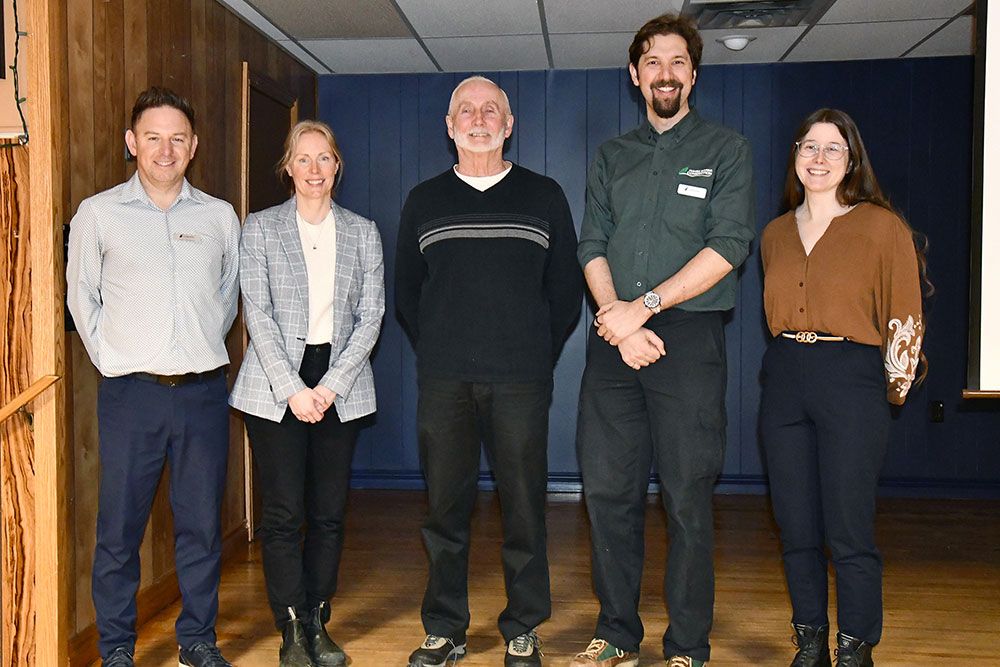
Meteorologist Trudy Kidd, of Environment and Climate Change Canada, speaks to Flood Emergency Planning Meeting in Exeter
Community Emergency Management Coordinators were among more than 30 people to attend annual Flood Emergency Planning Meeting hosted by Ausable Bayfield Conservation Authority
Community Emergency Management Coordinators and other municipal representatives, as well as police and fire department reps, were among more than 30 people who attended the annual Flood Emergency Planning Meeting in Exeter.
Ausable Bayfield Conservation Authority (ABCA) hosted the emergency preparedness meeting at Exeter Legion on Thursday, February 26, 2026. Trudy Kidd, Warning Preparedness Meteorologist at Environment and Climate Change Canada, provided the feature presentation.
Other presenters at the meeting included Davin Heinbuck, ABCA General Manager and Secretary-Treasurer, who spoke on the ABCA Flood Emergency Plan and roles and responsibilities. Also presenting were Daniel King, P. Eng, ABCA Water Resources Engineer and Flood Duty Officer; and Christie Brown, ABCA Water Resources Technologist.
Daniel spoke about flood event planning and Christie provided an update on current watershed conditions.
Meteorologist Trudy Kidd shared about new colour-coded weather alerts.
The colours indicate how a yellow weather alert indicates that hazardous weather may cause some damage, disruption or health impacts; while an orange alert indicates severe weather is likely to cause widespread or significant damage, disruption or health impacts.
A red alert indicates “ ... very dangerous and possible life-threatening weather will cause extreme damage and disruption.”
There are also improvements to provide additional messages designed to reach specific communities. “We recognize that early preparedness is essential,” she said.
Training and increased collaboration with other partners are some of the ways the Department continues to improve and to understand how storm events impact communities. She outlined how Environment and Climate Change Canada evaluates and improves its weather forecasting tools but she also explained some challenges and limitations to forecasts.
Forecasts can often provide an indication of a heavy rainfall event coming, she told the meeting, but they can’t always pin down exactly where rainfall or snowfall will hit hardest. Storm impacts can vary from location to location, with one community hit hard and another community not impacted as much. “Rainfall intensity is highly variable over short distances,” she said.
Forecasts inform decision-making but, she said, forecasts are more reliable for the near-term conditions than for longer-range projections. While a short-range forecast may predict impending storm events, seasonal forecasting is in its infancy, she said. It’s hard to determine with certainty the kind of spring we are about to have. This spring may end up being warmer than normal but seasonal forecasts can’t answer how much warmer or how many extreme weather events there might be or how much temperatures might fluctuate.
She provided examples showing sometimes ‘the rain doesn’t read the forecast’ and rainfall amounts can differ from projections. “Rainfall remains our most challenging weather element to forecast and work is being done at Environment Canada to improve weather detection, training, messaging, cooperation and coordination.”
She shared recent weather statistics from the London area. “The last time we had significantly wetter than normal was back in July 2024,” she said. There were local flood events at that time.
She summarized the weather this winter. This winter has been colder than normal and snowier than normal, she said, but overall precipitation values have been close to normal. December had colder than normal conditions. It was wetter than normal but not far from normal ranges. Temperature was somewhat colder than normal in January. February, at the time of the presentation, was drier than normal and temperatures were a little colder than normal but close to normal.
When it comes to climate change, a common question for extreme weather events is, ‘Did climate change cause these events?’ The short answer, she said, is “We can’t really say, one way or the other, if any single storm is caused by climate change, but it can increase the odds or the intensity of the impact of certain types of events.” As average temperatures continue to rise, the likelihood of those extreme weather events increases.
In his presentation, Davin explained how ABCA protects life and property through programs including flood forecasting and warning; emergency planning; regulations to direct development away from the most hazardous flooding and erosion areas; plan input and review; and other projects.
ABCA maintains a Flood Emergency Plan and a monitoring system and staff interpret forecasts and watershed conditions. They liaise with municipalities and provide technical assistance and they collect data, including snowpack and snow water equivalent and other local data. They input that data into a local flood forecasting model and forecast streamflow. Davin said flooding is infrequent but it does happen.
ABCA flood messages provide current, local and informed information on flooding events that are predicted or occurring. At the same time, some flood events can be unpredictable. For instance, the presence of ice jams can complicate things. During a flood event, ABCA issues flood messages. Depending on the extent of the predicted flooding, those messages could be 1. Watershed or Shoreline Conditions Statement for Flood Outlook and Water Safety; 2. Flood Watch; or 3. Flood Warning.
In his presentation, Daniel spoke about an updated new flood forecasting model that will be integrated into the program shortly. He spoke about the daily planning cycle and the rotation of three flood duty officers. Flood duty officers monitor the functioning of stations, streamflow trends, and three-day forecasts along with other roles. Their work is outlined by the Flood Emergency Plan and the Flood Operations Manual.
The flood duty officers review rainfall forecasts from multiple weather services and run an event-based model including forecast data as well as locally-gathered data (such as snow water equivalent and snowpack density through a snow survey).
The Flood Duty Officers also prepare the flood messages for municipal emergency managers and other partners, providing results from the model and observed watershed conditions.
In her presentation, Christie spoke about the watershed conditions which existed at the time of the meeting. She outlined existing ground conditions (wet, unfrozen soil), along with the average snow depth (15 centimetres) and average snow water equivalent (50 millimetres) in the snowpack. She also reported on the weakening ice conditions on local rivers.
She also provided temperature forecasts based on multiple sources and compared them. Based on current conditions and forecasts, there was low risk of ice jams, lake flooding, and riverine flooding at the time of the meeting. The risk of ice jams and riverine flooding was expected to increase moderately toward the end of the seven-day forecast period due to warmer temperatures and anticipated precipitation.
PHOTO – ENVIRONMENT CANADA METEOROLOGIST SPEAKS AT ABCA FLOOD EMERGENCY PLANNING MEETING – Presenters, at the 2026 Flood Emergency Planning Meeting, hosted at the Exeter Legion, by Ausable Bayfield Conservation Authority (ABCA), on Thursday, February 26, 2026 are (left to right in photo): Davin Heinbuck, ABCA General Manager and Secretary-Treasurer; Trudy Kidd, Warning Preparedness Meteorologist at Environment and Climate Change Canada; Ray Chartrand, Chair, ABCA Board of Directors; Daniel King, P. Eng, ABCA Water Resources Engineer and Flood Duty Officer; and Christie Brown, ABCA Water Resources Technologist.