Order trees now through new online store
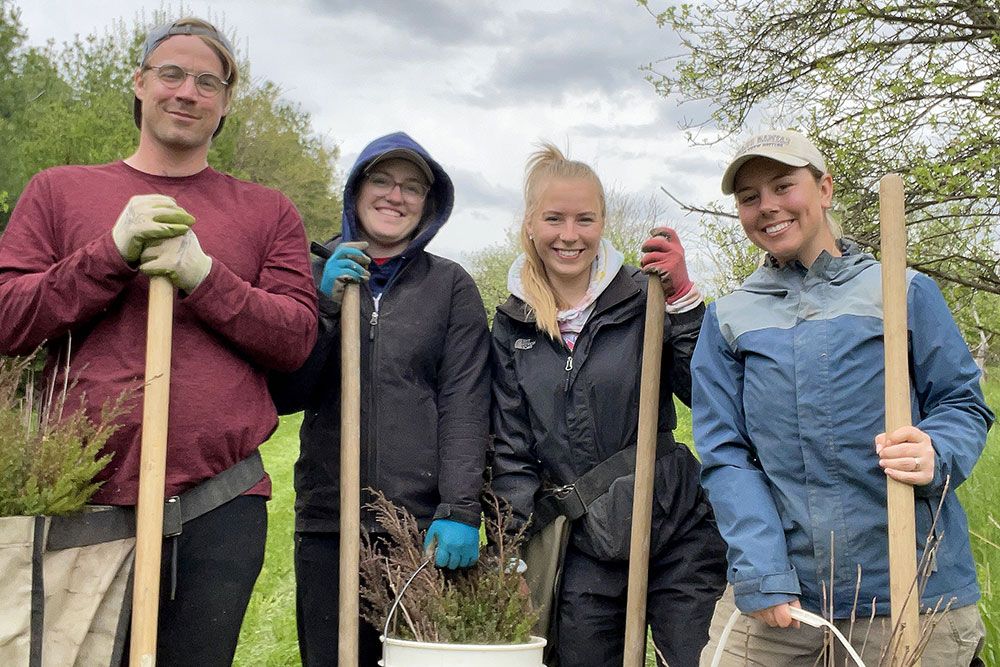
Local landowners have new way to order trees for spring planting in 2026
Landowners may purchase trees now through new online portal or with order form; Ausable Bayfield Conservation encourages you to become part of a long legacy of local tree planting, contributing to clean air, clean water, reducing soil erosion, protecting flood plains, enhancing farmlands, and creating much-needed habitat and travel corridors for birds and wildlife
Ausable Bayfield Conservation Authority (ABCA) invites watershed landowners to purchase trees through the spring tree order program. To make it easier to purchase trees this year, there is a new online tree order option. (Or, for those who prefer, there is a hard-copy printed tree order form or a PDF file download).
The spring tree order form is on the Order Trees web page. The new online purchasing portal link is also on that web page.
Trees are available on a first-come basis and stock availability is limited. Spring tree orders accompanied by payment, and online orders, can be made until February 28, 2026.
Ian Jean is ABCA Forestry Specialist. He said there is a long legacy of tree planting in local watersheds. One might assume tree planting hasn’t changed much over the years but, he said, a deeper look reveals shifting trends and approaches as knowledge, priorities and the landscape have evolved over time.
Large-scale tree planting began locally during the 1950s and 1960s. Tree cover was lower than today and there was great public concern for topsoil erosion by wind and water. The provincial government at that time operated tree nurseries and related infrastructure, in addition to providing funds to purchase land for reforestation.
“Tree seedlings grown at the government nurseries were provided at very low cost, a few cents per tree, to landowners willing to reforest large blocks of land,” Jean said. During that period, properties in areas like Hay Swamp were purchased by ABCA. They were planted with trees by the provincial Department of Lands and Forests. “Primarily these were conifers, mainly White Pine, planted at six feet apart or about 1,200 trees per acre,” he said.
During the 1970s and 1980s, changes to farming saw the proportion of land in pasture decrease, row cropping increase and crop fields grow larger. A shift to windbreak planting occurred to protect the larger fields from wind erosion. “The ABCA tree program started around that time to fill the need for windbreak planting,” said Jean. This complemented the provincial program, targeted to larger reforestation projects.
The provincial tree nurseries and related government tree planting ended during the 1990s. Conservation authority tree planting programs continued by wholesale purchasing seedlings from private nursery growers to offer to watershed residents. “Despite the increase in tree costs, people continued to plant trees,” said Jean. One advantage private growers offer is a greater range of species and types of planting stock.
“The importance of biodiversity is widely recognized, and people today are more likely to plant a variety of trees than just one type.”
Today, Ausable Bayfield Conservation offers a wide range of trees through its spring tree planting program. The Forestry Specialist encourages interested landowners to visit abca.ca for the spring tree order form or to give him a call at 519-235-2610 or toll-free 1-888-286-2610 to discuss planting projects.
“We can help with project design and help you to apply for funding for eligible projects,” he said. Funding programs are available in many areas for windbreaks or naturalization dependent on the type of project, location and specific program details.
If you have property on which you can plant trees, consider purchasing a tree through the tree order program. If you don’t have room on your property for trees, you can still help to improve forest conditions by donating to tree planting through the Carbon Footprints to Forests program.