Invasive tree threatens native Red Mulberry
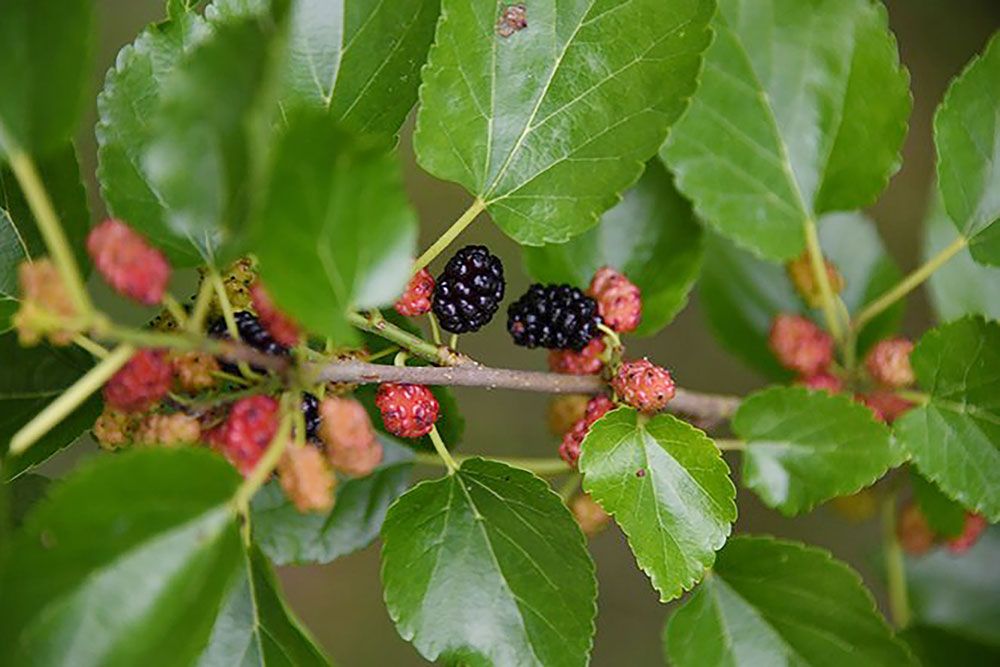
Feature – Invasive Species – December – 2025 – Focus on White Mulberry – Morus alba
White Mulberry poses serious threat to Ontario’s native Red Mulberry species by out-competing it and diluting the genetics through hybridization
By Renee Sandelowsky and Helen Varekamp
Renee Sandelowsky and Helen Varekamp are Bayfield residents and local volunteers. They are writing a monthly series of articles, for the Canadian Coalition for Invasive Plant Regulation, encouraging the planting of native species of plants and the removal of invasive species. This month (December 2025), their focus is the invasive plant White Mulberry – Morus alba.
Invasive species spread into our natural areas in many ways. For instance, birds and wind can carry seed. Humans can also spread invasive species by planting them.
We need to rethink our gardening practices to create healthy and functional spaces for our pollinators, other insects, birds and wildlife. That way, we can continue to reap the invaluable ecological services they provide. Those ecological benefits include pollination, decomposition, pest control, and food web integrity.
White Mulberry is a small tree growing up to 50 feet in height. It belongs to the Mulberry family. It is native to China where it has been used to feed silkworms for more than four thousand years. It was introduced to North America in the 1700s to establish a domestic silk industry. Today, White Mulberry is sold in many garden centres as an upright or weeping variety.
White Mulberry poses a serious threat to Ontario’s native Red Mulberry (Morus rubra L.) It not only out-competes Red Mulberry for habitat but also readily hybridizes with it, leading to genetic dilution. As a result, Red Mulberry trees are now rare. This native species found in the Carolinian forests of southern Ontario is listed as endangered both federally and provincially.
White Mulberries can adapt to many environments, produce lots of fruit and seeds, and invade forest edges and open areas. The unripe berries and milky sap of the White Mulberry tree are mildly toxic, while the large, shallow root system can damage infrastructure in urban areas.
Because many of the identification traits of Red and White Mulberry vary widely and overlap, distinguishing between the two can be challenging. In general, Red Mulberry leaves are larger, rougher and thinner than White Mulberry leaves, with an upper surface that is dull instead of shiny and a long, tapering tip. The lower surface of Red Mulberry leaves is fuzzy, whereas White Mulberry leaves are smooth on both sides. Red Mulberry fruit and flowers tend to be pendulous and long. White Mulberry flowers are stiff and shorter.
If you see a White Mulberry tree in the wild, you can report it to the Invading Species Hotline at 1-800-563-7711 or on EDDMapS Ontario.
How to Manage White Mulberry
Managing White Mulberry is challenging but achievable with persistence and a multi-step approach; several years of control may be needed, since the seeds can recolonize an area:
- Manual Removal: Small trees can be dug out by using a shovel, bush puller or weed wrench.
- Smothering: Larger trees can be cut to the ground and covered with a tarp to block sunlight and to prevent resprouting.
- Herbicide Treatment: Alternately, trees can be cut to the ground, followed immediately by herbicide treatment on the trunk, to prevent re-growth. Use herbicides only as a last resort, following all applicable regulations to minimize environmental harm.
After removal, replant the area with regionally appropriate native trees. This step is essential to prevent reinfestation and to restore ecosystem health. Native trees will also attract pollinators and wildlife, improving biodiversity in your yard.
A good choice, as an alternative tree to plant, would be Red Maple – Acer rubrum.
Learn More and Take Action
Education is key to combatting invasive plants. Learn to identify invasive species and choose native or non-invasive alternatives for your garden. Focus on managing one or two invasive plants at a time and be patient—successful eradication takes time and persistence.
To learn more, visit:
- Ontario Invasive Plant Council
- Canadian Coalition for Invasive Plant Regulation
- Grow Me Instead Guide